
Agents.md Explained: How One File Is Simplifying AI Coding Workflows
Ai for developers 101: bring order to AI coding with the agents.md file.

Hello reader,
If you’re a developer who uses AI coding assistants, you know the feeling: you’re constantly switching between different instruction files for every single tool.
What if I told you a new standard is picking up to bring some serious order to all that chaos — and it all boils down to one single file: agents.md.

Let's first understand the problem:
The last couple of years have been a complete explosion of AI coding agents.
You’ve got Claude, Cursor, Codex, Gemini CLI — the list just keeps growing — and here’s the catch:
Every single one of them uses its own special instruction file, its own set of rules in its own format.
That has become a massive headache for developers everywhere.
A single tweet captures it:
You stare at your project folder and have no idea which rule file the bot is actually listening to.
It’s, well, pure madness, a total mess of different markdown files for every tool, an endless cycle of repeating yourself.
This is my favorite way to describe the problem: your project stops being a codebase and turns into a markdown museum for confused bots.
You’ve got all these different instruction sets, each speaking a different language, and none of them talking to each other.
An elegant solution emerges
Thankfully, out of that chaos an elegant solution started to emerge. A bunch of major players in the AI space actually got together and agreed on a simple, predictable standard. The concept behind it is brilliant: a README for machines named agents.md.
What is agents.md?
At its core, agents.md is an open format for telling any AI what it needs to know about your project.
That “README for machines” idea is the best way to think about it.
It’s not for humans — it’s written specifically for your AI assistants. One dedicated spot for all your agent-focused rules and guidelines.
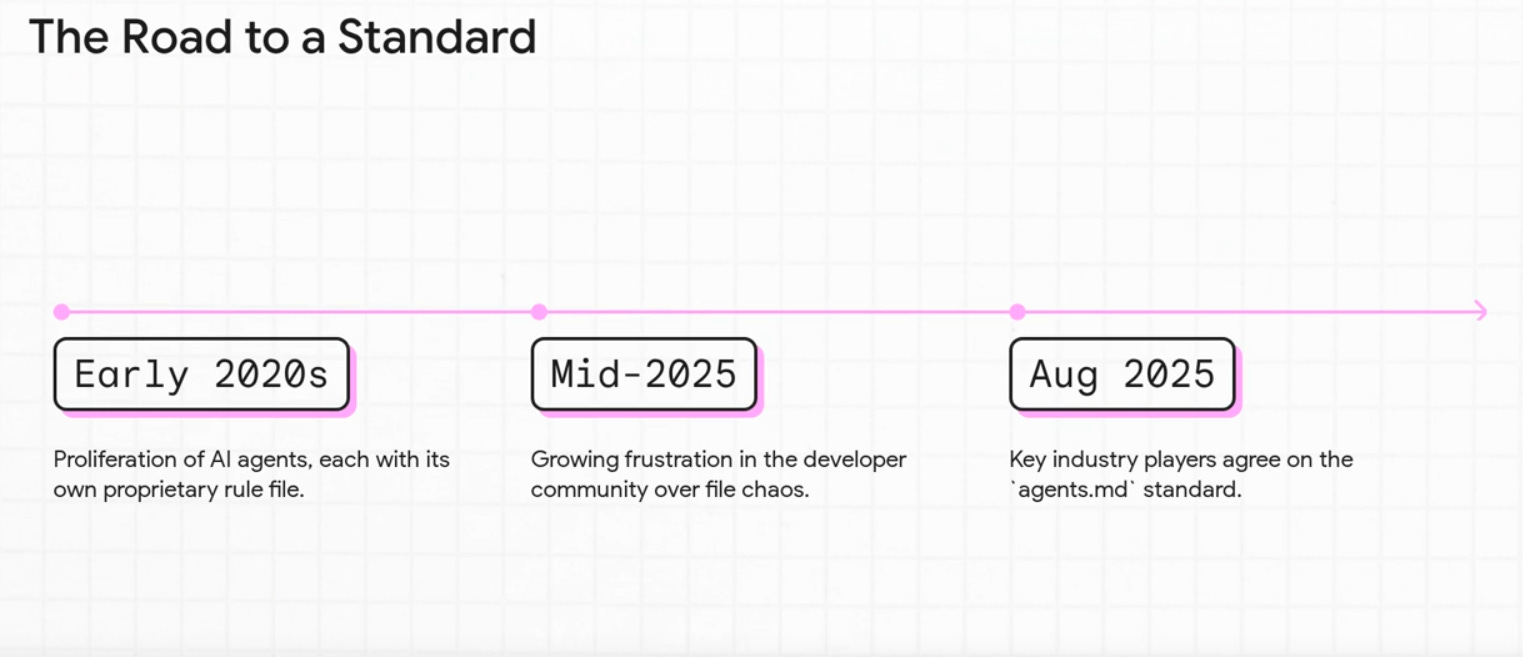
This didn’t happen overnight. As more tools hit the market, frustration grew and by mid-2025 the problem hit a boiling point.
That’s when companies like OpenAI and Google finally came together and said: okay, let’s fix this. They helped create the agents.md standard.
How it works — the practical playbook
How does it actually work?
Simply, think about what you’d tell a new human teammate on their first day.
This includes:
Project overview
Exact commands to build and run everything
How to run tests
Team-specific code style
Critical security reminders
It becomes the single source of truth for any AI agent that touches your code.
And the best part? It’s just markdown.
No new, complicated format to learn, no annoying YAML, no strict schema — the same standard markdown every developer already knows and loves.
That low barrier to entry is a big reason it’s catching on.
Scale and mono-repos: nested agents.md files
What about giant mono-repos?
They also thought of that: you can have nested agents.md files.
The rule is simple — an agent listens to the file closest to the code it’s working on.
That allows both project-wide rules and very specific local instructions.
Does that work at scale?
Consider this: 88 separate agents.md files were found in the main OpenAI repository when the standard launched.
That’s a staggering number and a strong proof point for the “closest file wins” approach in managing massive, real-world projects.
Adoption: who’s in and who’s out
A standard only matters if people use it.
Already, many heavy hitters are on board: OpenAI’s Codex, Google’s tools, Cursor, the Gemini CLI — they’ve all adopted the standard.
You’ll notice a big name missing:
Anthropic’s Claude still marches to the beat of its own claude.md file, creating a small standoff in the ecosystem.
Even with that holdout, the momentum is undeniable. The more tools that adopt agents.md, the harder it becomes for any one vendor to be the odd one out.
Why it matters for developers
So what’s the payoff?
At the end of the day, it’s about one thing: buying back your brain power:
Less time repeating yourself,
Less friction when switching between different AI tools,
And more consistency in code produced by agents because you set the rules once for everyone.
Agents begin to feel less like code vending machines and more like teammates that actually understand your project.
Conclusion
Agents.md is a huge step forward — it solves a real, annoying problem we face today.
But it also leaves a fascinating question:
As AI agents grow smarter, will a simple markdown file be enough to guide them, or is this the first step toward a totally new way of collaborating with our machine teammates?
Definitely something to think about.
Free PDF Roadmaps:
You can get these free PDFs that contain detailed roadmaps with recommended learning periods for each language or field, along with links to free resources such as books, YouTube tutorials, and courses with certificates:
The "markdown museum for confused bots" line cracked me up because that's exactly what my project directories looked like. Since this was published, Anthropic launched Agent Skills (agentskills.io) as a separate open standard in December, and now you've got two competing approaches trying to solve the same problem. Twenty-six tools have adopted Agent Skills so far. I wrote up the full landscape including where AGENTS.md and Agent Skills overlap and diverge: https://blog.devgenius.io/agent-skills-explained-teaching-your-ai-assistant-new-tricks-c6ee66a632c4