
No, AI Won’t Replace You. But It’s Already Doing This..
The AI Era developer road map..


Real Talk on Careers, AI, and the Future of Software Engineering
Welcome back to the Programmer Space newsletter.
Lately, the inbox has been overflowing with direct messages circling the same anxieties: the rapid evolution of AI, career viability, and the reality of software education.
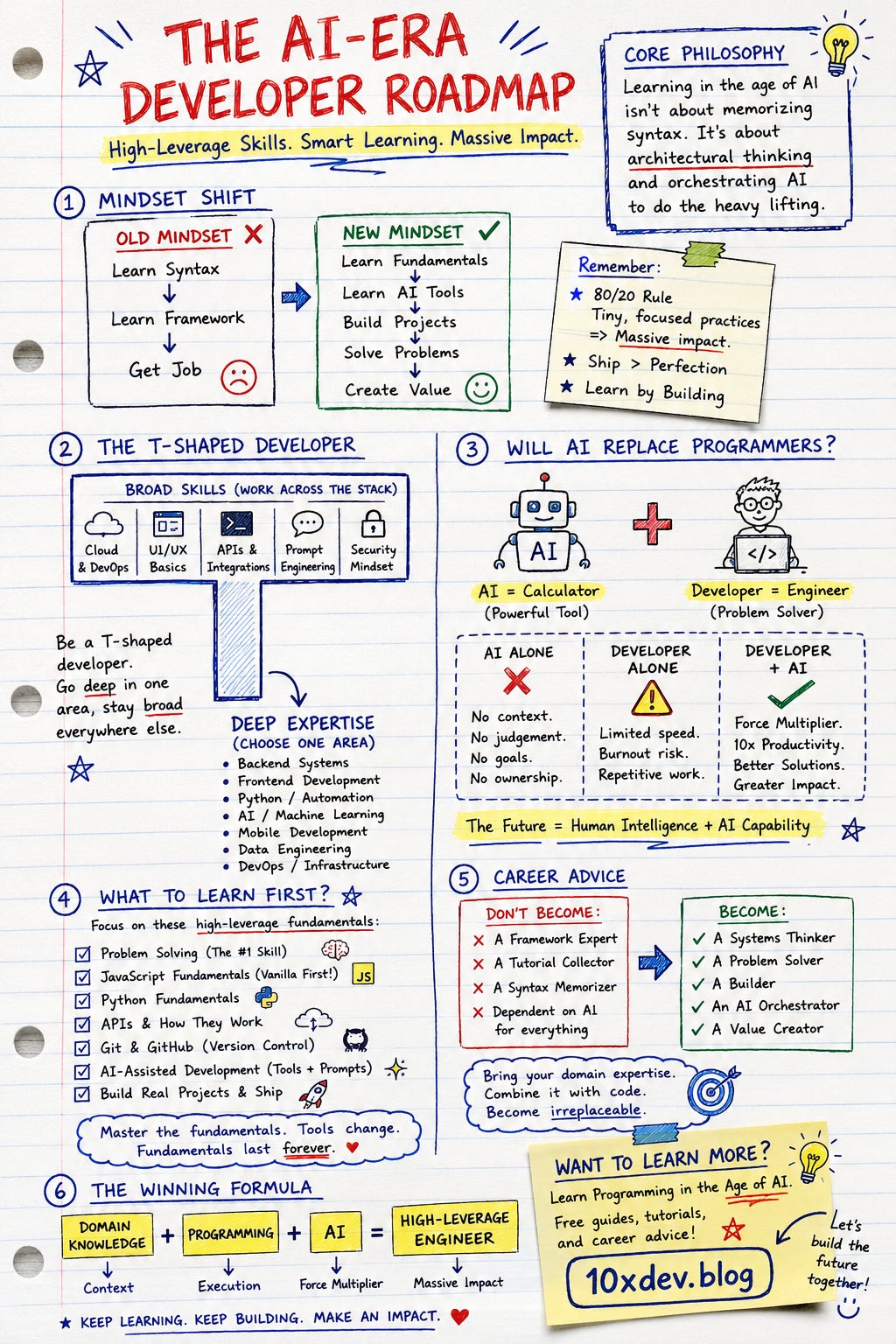
Before we dive in, let’s anchor this in the core philosophy of 10xdev.blog.
Learning programming in the age of AI isn’t about memorizing syntax anymore; it’s about high-leverage engineering. We advocate for “Smart Learning”—leveraging the 80/20 rule where tiny, focused practices yield massive impacts.
The era of the single-stack code monkey is fading. Today, we need architectural thinkers who understand the fundamentals (like Vanilla JS over heavy frameworks) and can orchestrate AI tools to do the heavy lifting.
Here are the unfiltered answers to your most pressing questions, with some added technical context from our resident Pythonista and technical co-author, Naima.
On Career Shifts and Getting Started
Q: Can I shift into a programming career at any age? Boucode: Yes.
Naima: The barrier to entry has actually lowered in terms of writing boilerplate code, but the barrier for problem-solving remains. If you are shifting careers later in life, bring your domain expertise with you. A former accountant who learns programming is immediately a top-tier fintech developer.
Q: Should I learn Frontend or Backend? Boucode: Whichever you actually enjoy.
Naima: Don’t stress over the label. Whether you start with server logic or client-side interfaces, focus on the “Core + Framework” architectural pattern. Learn how data flows. Once you understand the core mechanics, extending to either end of the stack becomes trivial.
On AI and the Future of the Industry
Q: Will AI replace programmers? Boucode: No, but it will clearly reduce the sheer headcount needed because it drastically boosts the productivity of existing developers.
Naima: Think of it like the shift from assembly language to modern high-level languages.
We didn’t stop needing engineers; one engineer just became capable of building an entire system. The goal now is to master agentic orchestration. If you can command AI agents to build out your architecture, you become a one-person tech lead.
Q: What skills are required to work in software right now?
Boucode: The multi-skilled generalists will be the luckiest and most in demand.
Naima: You need to be a “T-shaped” developer. Have deep knowledge in one area (like backend systems or Python automation), but maintain a broad understanding of cloud deployment, UI/UX, and prompt engineering. The more pieces of the puzzle you can connect, the more irreplaceable you are.
Q: Should I learn AI to understand it from the inside, rather than just using the models?
Boucode:
Yes, but if you do, prepare for a long, grueling journey. Half-knowledge here gets you nowhere. You need to love math more than you love prickly pears.
Naima: Using an API is software engineering; building a model is data science and heavy mathematics. If you want to peek under the hood of neural networks, you need to get extremely comfortable with linear algebra, calculus, and probability. If you just want to build cool apps, stick to leveraging existing Model Context Protocol (MCP) servers and APIs.
Q: Will AI have the same massive impact on tasks outside of writing code?
Boucode: Yes. Very, very, very much.
Naima: We are already seeing this in automated educational content, video generation, and system monitoring. Anything that relies on a repeatable, self-reinforcing feedback loop can and will be optimized by AI.
We are working on many series and roadmaps that you can actually enjoy while learning software development and programming in the age of AI!
P.S: If you want to learn Python (the official language of AI), we are also working on PyAcademy, a web app that makes learning Python fun, easy and interactive. Stay tuned for more info about it and free access for subscribers.
Thanks for being part of our community!
 | A guest post by
|
The shift isn’t being replaced. It’s becoming the editor of an AI that confidently produces bad code as fast as good code. The T-shape still matters because the depth is what catches the bad output. The 80/20 lands as: spend less time learning syntax, more time reading what the model writes for you skeptically.
The individual read here is right. The people who can think in systems and actually ship do get more valuable when the tooling gets good. I run an AI assistant across a few businesses daily, and the blurring of roles is real. I now do things that used to need three people. Here's the bit the 'super builders will rise' framing skips. Amplification lifts the ceiling for a small group. It does nothing for the floor. If one product-minded builder can suddenly do the work of five, the company does not want five times the output. It wants the same output from fewer people. That maths does not care how good you are with the tools. So 'super builders are rising' and 'headcount is falling' are the same sentence read from opposite ends. The person who masters the tool is not automatically the person the org keeps. Amplification and displacement run on the same track. Fewer chairs is fewer chairs, however talented the people left standing.