
Angular’s Back! Why v21 Just Made It The Best Framework of 2025
The Comeback You Didn’t See Coming


For a while, Angular was the reliable, enterprise-grade workhorse of the front-end world. Powerful, structured, and maybe a little… predictable.
In 2025, something has shifted. With the modern Angular v20+, the framework has shed its old skin and emerged as something new: a surprisingly modern framework that’s once again at the cutting edge.
Naima: For years, Angular carried a reputation for being the stable, enterprise-proven framework—powerful, structured, and focused on long-term reliability.
But starting with the modern Angular era (v20+), the framework has undergone a remarkable transformation. It’s cleaner, faster, signal-driven, and now back among the most innovative front-end frameworks in 2025.
If you need a metaphor for this transformation, look no further than the official v21 launch video, where Angular team member Mark Techson gets “sucked into a video game like Jumanji.” It’s the perfect analogy for this release—an adventure that is ambitious, fun, and completely game-changing.
This isn’t just another incremental update; it’s a bold leap forward.
In this article, we’ll break down the key features that make Angular 21 such a monumental release. We’ll explore what these changes mean for your daily workflow and why, from our personal perspective, this evolution is one of the most exciting things to happen in web development.
The v21 Features: What You’ll Actually Use
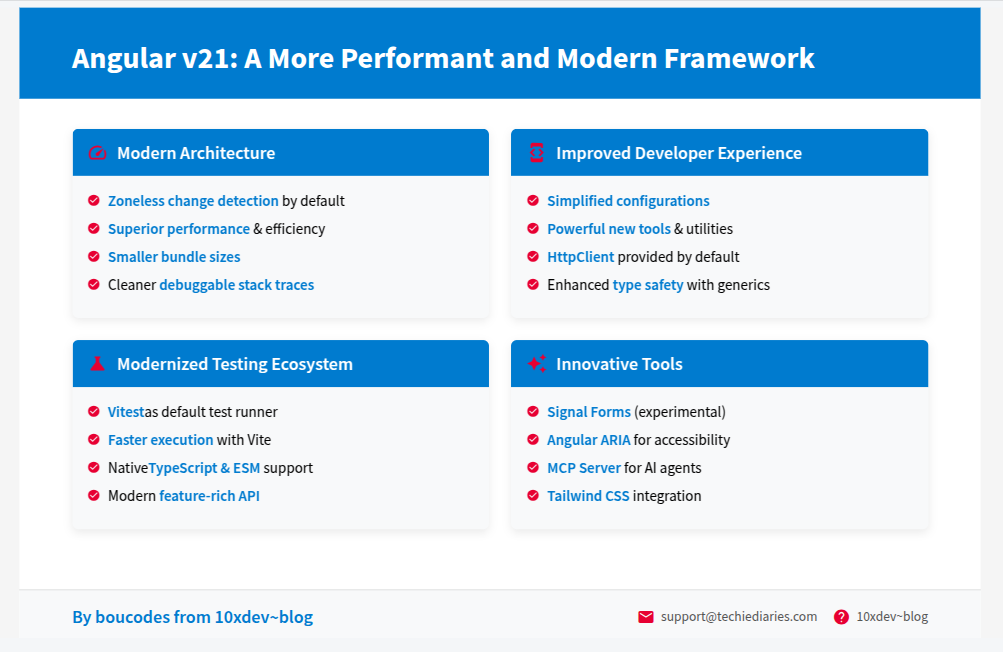
Beyond the hype, Angular 21 delivers a set of tangible, powerful features that will fundamentally improve the developer experience, performance, and capabilities of your applications.
But these aren’t just disconnected items on a changelog.
They tell a story: Angular is shedding its legacy complexities in favor of a modern, explicit, and performant core centered around Signals and Vite.
Naima: I’m so excited to share this with you! 😍
This is part of my brand-new project on 10xdev Blog, where I build super engaging interactive roadmaps.
If you want to explore something beautiful, dynamic, and fully narrated, you’ll absolutely love my latest creation — a complete Angular 21 learning roadmap:
https://10xdev.blog/angular-21-deep-dive-mind-mapAnd please feel free to send me any feedback — I’d love to hear your thoughts!
Let’s dissect the most important changes.
Signal Forms (Experimental)
Angular 21 introduces an eagerly awaited, fully reactive way to handle forms built on the foundation of Signals.
The new form() function takes a signal-based data model and creates a corresponding reactive form tree.
You then use the [field] directive to create a simple, two-way binding between your template inputs and the form’s signal model.
These are some of its features:
• Declarative and Reactive: Defines the form model as a signal that automatically stays in sync with the UI. Any change in one place is instantly reflected in the other.
• Full Type-Safety: Provides a more ergonomic and less error-prone developer experience when accessing form fields.
• Simplified State Management: Eliminates the boilerplate and complexity associated with traditional form management, creating a cleaner, more intuitive approach.
This is a massive step forward for one of the framework’s most critical features. While the API is still experimental, it’s a clear path to a more reactive future for forms in Angular.
Zoneless by Default
This is a big shift, and it’s directly connected to the rise of Signals. New applications generated with Angular 21 are now zoneless by default, removing the long-standing dependency on Zone.js.
Naima: With Signals now explicitly managing state, the “magic” of Zone.js is no longer necessary for change detection.
So what does “explicit” change detection actually mean?
It means change detection now runs only when triggered by specific actions you control:
• A Signal’s value is updated in a template.
• User-bound events (like clicks or inputs) are fired.
• The async pipe emits a new value.
• markForCheck() is called manually.
• ComponentRef.setInput() is called.
For those of us who’ve spent hours debugging Zone.js-polluted stack traces, this change alone is worth the upgrade. It’s a huge win for developer sanity and application performance.
Vitest Takes the Throne: Modern Testing is Here
After years of relying on Karma and Jasmine, Angular has officially crowned a new king of testing.
Vitest is now the default test runner for all new projects and is stable and ready for production use with the ng test command.
This is more than a simple swap; it’s a strategic alignment with the modern Vite ecosystem, signaling Angular’s commitment to breaking out of its historical tooling.
Finally, our testing workflow feels like it belongs in the same decade as the rest of our toolchain.
Naima: For teams with existing projects, Karma and Jasmine are still fully supported by the Angular team, so you don’t need to migrate right away.
HttpClient is Now Built-in
Here’s a quality-of-life improvement you’ll appreciate on day one: the HttpClient is now included by default in new applications.
That’s right—no more manually importing HttpClientModule or adding provideHttpClient() to your root providers just to make a simple API call.
Naima: While HttpClient is now built-in by default, the
provideHttpClient()function still serves a purpose. Developers can use it to configure advanced options, such as enabling the Fetch API or registering custom HTTP interceptors, if they require more control over HttpClient’s behavior.
It’s a small change that removes a piece of friction every single developer has encountered, and it perfectly embodies the developer-first focus of this release.
Angular Aria (Developer Preview)
In response to developer demand for more flexible and accessible components, the team has introduced Angular Aria, now in Developer Preview.
This new library provides a collection of headless Angular directives that implement common UI patterns with accessibility as the number one priority with these features:
• Unstyled by Design: It provides 8 common UI patterns and 13 unstyled directives, giving you full control over the look and feel while ensuring the complex parts are handled for you.
• Accessibility Guaranteed: Handles ARIA attributes, keyboard interactions, and focus management out of the box.
• Modern and Signal-Based: Built using modern Angular directives and Signals, ensuring they are both powerful and easy to customize.
AI-Powered Tooling: The MCP Server is Now Stable
Angular is fully embracing the future of development with its MCP (Model Context Protocol) server, which is now stable.
This tool is designed to enable AI agents and modern tooling to better understand, analyze, and write modern Angular code.
It acts as a bridge, giving LLMs the context they need to generate up-to-date, high-quality code.
This isn’t some abstract future concept; it provides concrete tools today, such as:
The
ai_tutorfor interactive learning
And the
onpush_zoneless_migrationtool that provides a step-by-step plan for modernizing your app.
These technical upgrades are more than just a list of features. Angular is also shipping a suite of new migration scripts (ngclass-to-class, common-to-standalone) and CLI support for Tailwind CSS, proving that v21 is a comprehensive update focused on modernizing every part of the developer workflow.
A Personal Journey with Angular
Our connection to Angular isn’t just professional; it’s a core part of our history as developers and content creators. It’s a technology that has shaped our career from the very beginning.
We started writing about Angular way back in 2016 on our first blog, techiediaries. In those early days, our tutorials on AngularJS and the then-new Angular 2 were some of the first articles we wrote that truly went popular.
In fact, the initial popularity of our site was built almost entirely on the back of its Angular content. When we later rebranded to 10xdev blog, our focus expanded, but Angular has always remained a special and foundational technology for us.
We admit, there was a period a few years ago when it felt like Angular was getting left behind. The newer, “cool-kid” frameworks were grabbing the headlines, and it seemed like Angular’s best days were in the past.
But look at it now. Thanks to its embrace of Signals, a modern Vite-powered toolchain, and integrated AI tooling, you could argue that Angular is more cutting-edge today than ever before.
Why You Should Revisit Angular in 2025
Angular 21 is a landmark release. It’s not just an update; it’s a statement. The framework is faster, the developer experience is cleaner, and the new features make it more powerful and enjoyable to use than at any point in its history.
From the reactive power of Signal Forms to the raw performance of a zoneless architecture, Angular has been thoughtfully modernized from the ground up.
If you’re an Angular developer today, don’t hesitate to start exploring. And if you’re one of the many who moved on to other frameworks, we invite you to take another look. This isn’t the same old Angular.
PDF Roadmaps
See our collection of PDFs with detailed roadmaps and recommended learning periods for each tech, along with links to resources such as books, YouTube tutorials, and courses with certificates:
By bou~codes and Naima.
 | A guest post by
|